


Why Professional Cleanings Matter
Billions of bacteria are in our mouths, even when we brush our teeth. Most of these microorganisms are harmless and helpful, but some can cause tooth decay and gum disease. Regular brushing and flossing can help reduce harmful bacteria and keep our mouths healthy. But even the most diligent person can miss a spot or two. That's where professional teeth cleaning comes in. At Cloud Dental, we recommend teeth cleaning every six months to maintain healthy teeth and gums.
What is Dental Cleaning?
Dental cleaning is a broad term for various procedures that clean your teeth and gums to maintain your dental health. These procedures can help prevent gum disease, treat cavities, and more. Cleaning is a routine part of your dental care and helps your dentist spot potential problems early. You can say that dental cleaning is the "tune-up" for your teeth. And, like your car, you need regular checkups to keep your teeth running smoothly and efficiently.
Benefits of Dental Cleaning
Getting professional cleaning is an excellent way to prevent gum disease. It also improves your overall oral health and helps to keep your mouth smelling fresh.
- Prevent Gum Disease: Gingivitis is a precursor of gum disease–a serious condition that can lead to tooth loss if left untreated. Regular professional cleaning treats gingivitis by removing any bacteria and plaque from your gums.
- Whiter Teeth: Dental cleanings can remove the stains that at-home brushing and whitening products can't.
- Fresher Breath: Bacteria and food particles can cause bad breath. Dental cleanings will remove these and leave your mouth feeling refreshed.
- Early Detection of Oral Problems: Dental professionals can spot oral health problems in their early stages during a cleaning. This allows you to get treatment before the problem becomes more serious.
- Prevent Cavities: Plaque is full of bacteria that eat away tooth enamel, causing cavities. Regular cleanings will help prevent this from happening.
- Lower Risk of Heart Disease: Studies have linked periodontal disease to an increased risk of heart disease, so keeping your gums healthy is important for overall health.
Types of Dental Cleanings
Depending on your oral health, your dentist or hygienist may suggest routine prophylaxis or more aggressive cleaning.

Prophylaxis Dental Cleaning
Prophylaxis comes from the Greek word prophylaktikós which means "to prevent." Prophylaxis dental cleaning is a preventative measure to remove tartar and bacteria that can cause gum disease. It is the basic dental cleaning you get from your dentist every six months.
Dental plaque is a sticky, colorless film of bacteria that forms on our teeth. Tartar, also known as calculus, is mineralized plaque that has hardened and attached to your teeth. Plaque and tartar can cause various problems, from tooth decay and gum disease to bad breath. Regular teeth cleaning removes plaque that builds up on your teeth, preventing cavities, gingivitis, and periodontitis.
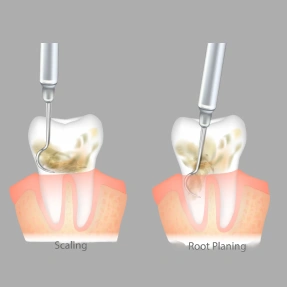
Scaling and Root Planing
Scaling and root planing (deep cleaning) is a more invasive form of teeth cleaning. This procedure targets the roots of your teeth, as well as the gum pockets. The process is not surgical but requires several sessions at the dentist's office.
During scaling and root planing, the dentist scrapes plaque and tartar from your teeth above and below the gum line. Then, the dentist smoothes the roots of your teeth to prevent bacteria from re-accumulating. The root planing process also allows the gums to reattach to your teeth.
Depending on the severity of the disease, the dentist may also administer antimicrobials to reduce the risk of infection. Scaling and root planing is not usually done under routine care but is needed to treat gum disease.

Full Mouth Debridement
The dentist may need to do some debridement during a routine checkup. This cleaning is usually done when a person has not had their teeth cleaned in a while or has a lot of tartar and plaque buildup. This allows the dentist to diagnose and treat problems such as cavities and gum disease and to prepare the teeth for other procedures.
Debridement is performed to remove plaque and calculus that are too deep to be brushed off with ordinary toothbrushes. When these deposits build up on the teeth, they can make it difficult for the dentist to check for cavities and other problems. A full mouth debridement can be a very thorough and uncomfortable cleaning, but it is important for keeping the teeth and gums healthy. The dentist may use an anesthetic to ensure the patient is comfortable.
Although implant-supported bridges are more expensive than traditional bridges, they offer many benefits, including improved function and aesthetics, increased comfort level, and greater durability. Additionally, they can help preserve the jawbone and prevent further bone loss.
What Happens During a Routine Teeth Cleaning?
A routine teeth cleaning removes plaque, tartar, and surface stains while polishing your teeth for a smooth finish. Your hygienist also checks your gums and overall oral health, helping prevent problems and keep your smile healthy.
The first step in a prophylaxis cleaning involves a complete examination of your oral cavity. The dentist will check for mouth sores, cavities, and any signs of periodontitis. They will ask about your current medication and other changes to your medical history. They may ask for a dental x-ray to check for cavities, bone levels, and impacted teeth.
The dental hygienist will measure the depth of your gum pockets. These pockets are the spaces between the gums and your teeth. They are a common sign of gingivitis. The presence of plaque can also lead to the formation of pockets.
Gum pockets vary in size, indicating healthy gums or gum disease. Healthy gums have pocket depths of 1-3 millimeters. A larger pocket indicates a more serious condition. The information will help your dentist determine your gum health and how serious your gum disease is
Tartar is a hard substance that can form above and below the gum line. Once it forms, you may not be able to remove it using your toothbrush and floss. To remove tartar and plaque buildup, the dentist will use special instruments to scrape the buildup from your teeth.
If there's a lot of tartar, the dentist may use an ultrasonic scaler, which uses vibrations to break up the tartar. In some cases, plaque and tartar can be difficult to reach with traditional cleaning methods. The dentist may recommend using a laser or another power tool to remove the buildup.
Dental polishing is a process of smoothing teeth with a rotating brush and abrasive paste. It is usually done after cleaning to remove any remaining plaque or tartar from the teeth. Polishing can also help to remove surface stains and make the teeth look brighter.
The first step in dental polishing is to apply a small amount of gritty toothpaste or gel to the bristles of the rotating brush. The brush is then placed in the person's mouth and moved around all of the surfaces of the teeth.
The aim is to gently scrub away any plaque or tartar that may be present. After a few minutes, the toothpaste or gel will have been worked into all of the nooks and crannies of the teeth and have started to break down any plaque or tartar that was there.
A professional fluoride treatment at the dentist's office is usually in the form of a gel, foam, or varnish applied directly to your teeth. The fluoride concentration in these products is much higher than what you would find in over-the-counter products. The gel or foam is usually brushed onto your teeth for one minute before being rinsed. The varnish is applied with a small brush and left on for several hours.